

How Francesco Roccazzella built a dual career between academia and Central Banking
lfin |
A doctorate does not lead to just one career path. After completing his PhD at UCLouvain, Francesco Roccazzella moved into academia as a finance professor and later into central banking as a Senior Economist at the National Bank of Belgium. His trajectory illustrates how doctoral training can open both academic and policy oriented careers, and how research skills translate into real world economic decision making.
For many prospective PhD candidates, one question dominates: what comes after the doctorate? Francesco Roccazzella’s path offers a concrete and reassuring answer. Trained in finance and monetary economics, he completed his PhD at UCLouvain, then combined teaching, publishing, and applied research before moving into a senior economist role at a central bank. In this interview, he reflects on his motivations, key PhD milestones, and how doctoral training continues to shape his work today.
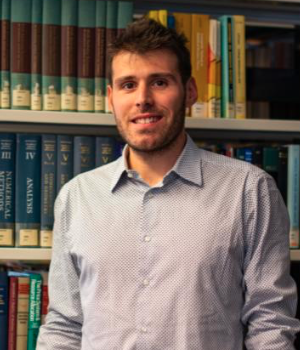
What led you to pursue a PhD and why at LIDAM UCLouvain?
It was a mix of personal motivation and opportunity. During my MSc, I spent almost a year in the research and analysis department of the Bank of Slovenia. That experience strengthened my desire to go deeper into research and explore new questions. My MSc advisor suggested that a PhD would be the natural next step.
Around the same time, I attended several research presentations, including one by a former head of financial markets research at the European Central Bank who had completed his PhD at UCLouvain. He strongly recommended the program and emphasized its strengths in economics and econometrics. On a more personal note, my partner is Belgian and had studied at UCLouvain, which also helped make the decision easier. Altogether, it felt like the right moment to apply.
I chose to stay at UCLouvain because the research agenda and the academic environment matched exactly what I wanted to pursue in finance.
How did you experience your PhD years in practice?
My PhD years were truly an adventure. The first major challenge was securing funding. Obtaining a teaching assistant position at the Economics School of Louvain was a turning point. It allowed me to fully pursue my research, attend international conferences, and gain direct teaching experience, which is a major asset for an academic career.
One of the most memorable milestones was receiving my first acceptance for a peer reviewed journal article. It was a strong confirmation that long periods of work and revision eventually pay off. It remains one of the most rewarding moments of my doctorate.
If I had to summarize the main lesson, it would be perseverance. Progress during a PhD is rarely linear. Failure and revision are normal. What makes the difference is resilience and consistency. A supportive environment is also essential. I benefited greatly from engaged supervisors and colleagues, as well as from a strong PhD cohort. We shared ideas, organized mock presentations, and supported each other through conferences and the job market.
The PhD is the moment when you stop being a student and start becoming an independent researcher.
Which moments most shaped your professional direction during the PhD?
Teaching played an important role. Being in front of students, building courses, and explaining complex topics clarified for me that I wanted academic teaching to be part of my career. At the same time, publishing and presenting research internationally confirmed that I wanted to stay active in high level research.
These two dimensions, teaching and research, shaped my first step after the PhD into a professorship in finance.

How did your transition from academia to the National Bank of Belgium happen?
After completing my PhD, I joined IESEG School of Management as a professor in finance. There, I developed new courses, completed a pedagogical certification, and continued publishing and presenting my research. I also launched new projects with various collaborators.
Over time, through shared research interests and ongoing collaborations, an opportunity emerged with the National Bank of Belgium. The move made sense intellectually and professionally. It allowed me to continue academic style research while also contributing directly to policy analysis and decision making.
This dual dimension is what makes the role particularly stimulating. I can publish and contribute to the academic literature, while also applying the same tools and methods to concrete financial stability and macroprudential policy questions.
My PhD did not just give me techniques. It gave me a structured way of thinking about economic mechanisms.

What does your current role look like on a daily basis?
My work combines policy oriented modeling and academic research. On the policy side, I maintain and develop econometric frameworks used to analyze the Belgian credit cycle. These models support policymakers by providing evidence based assessments of financial stability risks and the effects of macroprudential measures.
In parallel, I conduct research on topics of shared interest with the central bank. This means formulating research questions, building empirical strategies, and contributing to the broader literature, while ensuring that results also inform policy discussions. It is a continuous interaction between theory, empirics, and application.
How does your PhD training still support your work today?
The PhD trained my mindset. It taught me how to approach complex problems in a structured and rigorous way, starting from the literature, identifying the right question, and selecting the appropriate methodology.
Those habits are central to everything I do today. Whether I work on an academic paper or a policy model, I rely on the same core skills: critical thinking, methodological discipline, and clear communication of results.
What would you tell someone who is unsure about starting a PhD?
Think carefully and gather information. A PhD is not simply an extension of a master’s degree. It is a different type of journey, with much more independence and uncertainty. There is no predefined path, and you shape much of the experience yourself.
Choose a broad topic that genuinely motivates you and stay intellectually open. Do not lock yourself too early into narrow silos. Be prepared for setbacks and learn to recover from them. Failure is part of the process.
Finally, choose your environment and supervisor with care. You need a place where you feel comfortable and supported, and a supervisor with whom you can openly discuss doubts and disagreements. That relationship is one of the key success factors in a PhD.
A PhD is an investment in your intellectual capital, not a predefined career outcome.
Looking back, would you make the same choice again?
Yes, without hesitation. The PhD gave me rigorous training, intellectual independence, and access to both academic and policy careers. It was demanding, but it created opportunities that continue to shape my work today.
Francesco Roccazzella completed his PhD at UCLouvain in 2023, after MSc degrees in Finance and in Money and Finance from the University of Siena and the University of Ljubljana. He served as a teaching and research assistant at the Economics School of Louvain, then as Professor of Finance at IESEG School of Management. Since 2026, he is Senior Economist at the National Bank of Belgium, combining academic research with policy oriented economic analysis.