News
2026-06-17
B3N3-Substituted in 2D Carbon Covalent Organic Frameworks
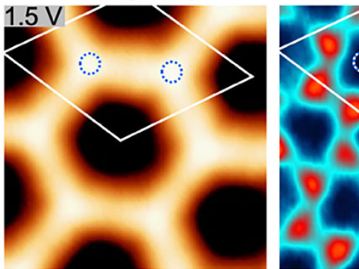
Covalent organic frameworks (COFs) are a versatile class of materials whose structural, electronic and functional properties can be tailored by selecting the geometry and chemical composition of their linker and spacer moieties. We have synthesized single-layer B3N3-linked 2D COFs with biphenyl and quaterphenyl spacers on Ag(111) and Au(111) under ultra-high vacuum conditions. The comprehensive experimental characterization combined scanning tunneling microscopy, bond-resolved atomic force microscopy and photoemission spectroscopy. Density functional calculations revealed differences between the two BN-substituted COFs and their carbon-based analogues. The conduction bands of the COFs are primarily derived from electronic states of the spacer units. Introducing B3N3 linkers into the COFs increases the band gap and reduces frontier band dispersion, effects that can be further modulated by the length of the spacers. Additionally, the site-selective dehydrogenation of B3N3 nodes is shown to locally modify the COF's electronic properties. We thus demonstrate the effect of atomically precise B3N3 substitution on the electronic structure of two distinct kagome systems, through a comparative analysis of isostructural BN and CC substituted COFs. These results establish a new strategy for developing stable, metal-free COFs with structural diversity and programmable band structures, offering insights into the controlled BN-doping of low-dimensional carbon nanostructures.
Read article
2026-06-17
A Single-Phase Mixed Ion-Electron Conducting Metal−Organic Framework
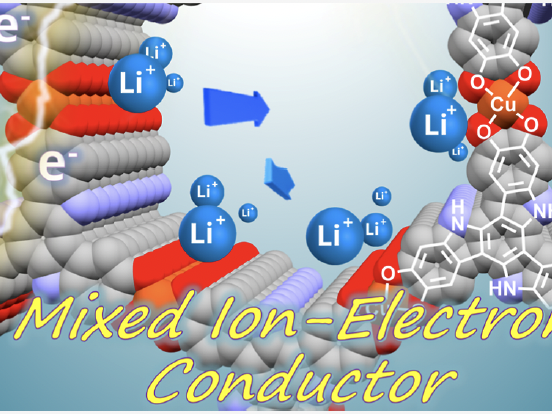
Mixed ionic-electronic conductors (MIECs) are highly sought after for electrochemical systems because they support concurrent charge and mass transport. Yet, structurally well-defined single-phase MIECs remain scarce, as most systems rely on physical mixtures of ionic and electronic conductors. Here, we introduce a cation-rich design strategy to realize solid-state mixed Li+-electronic conduction in a two-dimensional copper–catecholate metal–organic framework, Cu3(HOTAT)2, built from the 3-fold symmetric new ligand 2,3,7,8,12,13-hexahydroxytriazatruxene (HHTAT). Owing to the combined redox activity of Cu2+/Cu+ and the HOTAT ligand, controlled fractional reduction generates a family of LixCu3(HOTAT)2 (0 ≤ x ≤ 7.50) phases with tunable transport properties, in good agreement with electronic-structure calculations. The Li-rich phase Li7.50Cu3(HOTAT)2 exhibits intrinsic mixed conduction at room temperature, with an electronic conductivity of 2.8 × 10⁻³ S cm–1, and solid-state Li+ conductivity of 1.1 × 10⁻³ S cm–1. As a proof of concept, Li7.50Cu3(HOTAT)2 operates as a homogeneous cathode in all-solid-state Li batteries, delivering 100 mAh g–1 after 100 cycles with ∼99.8% Coulombic efficiency, indicative of highly reversible electrochemical behavior. These results establish cation-rich reduction of redox-active 2D MOFs as an efficient route to engineer solid-state mixed Li+-electronic conductors, opening a pathway toward dual-conducting porous materials for solid-state electrochemical technologies.
Read article

2026-04-24
Second Prize for Best Poster - Annual European Rheology Conference AERC 2026
Congratulations to Victor CHAMBON who won the Second Prize for Best Poster at the Annual European Rheology Conference AERC 2026 for his poster entitled "Aqueous silicate : Study of Very High Shear Modulus Viscoelastic Liquid" by V. Chambon, A. M. Jonas, E. van Ruymbeke
Read article