

Measurement and recording
ipsy | Louvain-la-Neuve
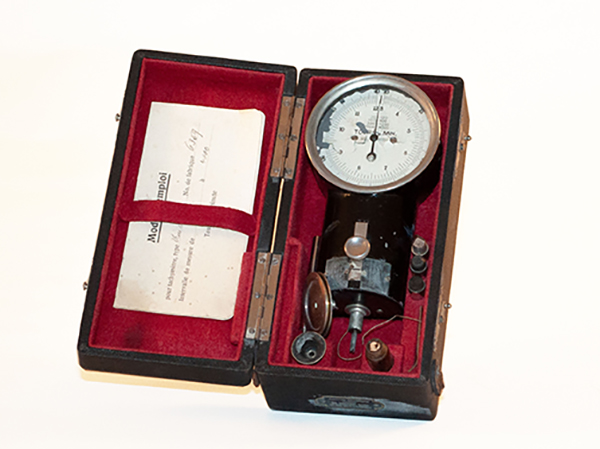
25. Tachometer
Description:
* The tachometer, or revolution counter, measures the speed of rotation of a piece in motion.
* It is connected to the shaft of the motor.
* It comes with the following accessories: steel tip for speeds under 500 rpm; rubber tip for speeds over 500 rpm; rubber sleeve for measuring the number of spindle revolutions; rubber tip with tapered recess for measuring very thin shafts; extension rod for hard-to-reach shafts.
Operation:
* In the laboratory of experimental psychology, numerous electromechanical rotation devices were used.
* The tachometer served to measure and adjust the rotational speeds of these instruments.
*The tachometer shaft is positioned in line with the shaft whose speed is to be measured.
* Contact is established between the two shafts.
* Beforehand, the cursor of the tachometer is placed on the selected measurement interval.

26. Electrodiapason
Description:
* The electrodiapason is a tuning fork whose vibrations are sustained by an electromagnet.
* Mounted on a wooden base, it is connected to an electric coil made of copper.
* At the end of one of the tuning fork's arms, a metal wire and a knob ensure electrical contact.
* Eight pins fixed into the wooden support serve to provide power to the device, to insert a resistor and/or capacitor, and to collect the signal.
*An electrical circuit under the wooden support connects these pins to one another.
Operation:
* The electrodiapason was used to check the accuracy and regularity of Hipp's chronoscope measurements.
* To this end, the tuning fork was connected to a cylinder by Marey (device no. 31), which was rotated at high speed to trecord the vibrations.
* By means of a commutation device (Morse key), the chronoscope and tuning fork were activated simultaneously.
* After a while, the operation was interrupted and the time indicated on the chronoscope was compared with the number of vibrations recorded on the cylinder.

27. Telegraph receiver
Description:
* In 1838, with the invention of the “Morse code”, it became possible to transmit texts via short and long electrical impulses.
* A telegraph receiver enables these messages to be recorded.
* A clockwork mechanism unwinds a ribbon of paper, and electromagnets actuate a stylus that marks dots and dashes on the ribbon.
Operation:
* On receiving an electrical signal, the electromagnets activate the stylus, which then traces the running ribbon.
* If the signal is interrupted, a spring retracts the stylus, leaving the ribbon blank.
* In psychology, experimenters realized that a telegraphic receiver enabled precise recording of participants' responses in experimental set-ups.
* Graphic recording was continuous, and the registration system was activated both when the stimulus was presented and when the participant responded.
* The data recorded on the tape furnished accurate data about reaction time, frequency of response, duration of response, latency between responses, and so on.
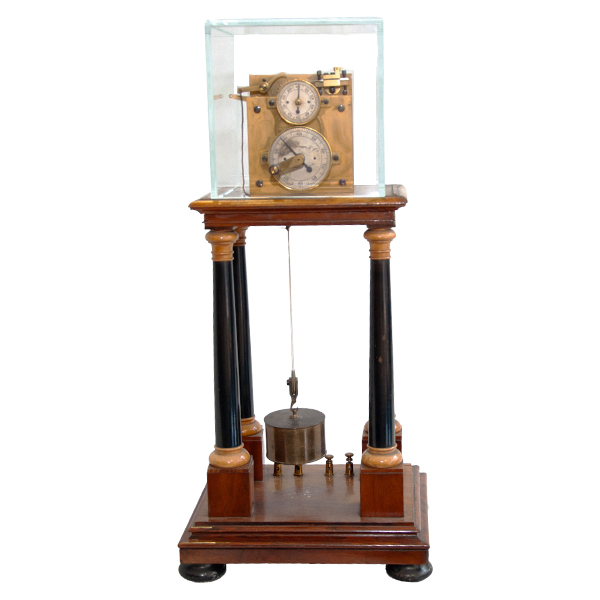
28. Hipp's Chronoscope
Description:
* A chronoscope is a clock capable of recording very short time intervals.
* In psychology, it was mainly used to measure response times to sensory stimuli.
* The model by German watchmaker Matthaüs Hipp, accurate to a thousandth of a second, was extremely successful.
* Its movement is secured by a brass counterweight.
* The chronometer element is not a pendulum, but a metal plate that vibrates 1,000 times per second.
* Every thousandth of a second, the vibration releases a notch on a toothed wheel, triggering the rotation of the clock needle.
* The mechanical operation of the device was subject to wear and tear.
* It could be recalibrated using a device combining an electrodiapason (device no. 26) and a cylinder of Marey (device no. 30).
Operation:
* The chronoscope was triggered on presentation of the stimulus.
* The participant used a telegraph key connected to the chronoscope to signal their response, thereby stopping the movement of the clock.

29. Kymograph
Description:
* Designed in 1846 by physician and physiologist Carl Ludwig, the basic principle of this device is similar to that of Marey's cylinder (device no. 30).
* It enabled physiological or mechanical variations to be recorded in the form of graphic tracings on a rotating cylinder.
* The cylinder was wrapped with smoke-blackened paper, and its speed of rotation was controlled by a clockwork mechanism.
* The kymograph could be mounted on either a vertical or horizontal axis.
Operation:
* A stylus connected to a sensor placed on a site on the participant's body translated physiological or muscular variations into stylus actions.
* The stylus then traced these variations in the form of curves on the rotating cylinder.
* The resulting curves, or kymograms, were used to analyze dynamic phenomena such as heart rate, breathing, or muscular responses.
* In experimental psychology, it was also used to record a variety of time-related events such as reaction time, duration and frequency of response.

30. Marey cylinder (2 models)
Description:
* The Marey cylinder is a device for recording physiological and physical phenomena.
* Although he didn't invent the device, Etienne-Jules Marey (physician, physiologist and pioneer of chronophotography) refined it for the study of movement and locomotion by improving the sensitivity of the tracing device.
* The Marey cylinder is mounted on a base whose horizontality can be adjusted by means of three jacks.
* It consists primarily of a cylinder that revolves on itself, held at each end by two spikes embedded in a support, and a metal case containing a spring mechanism wound with a key.
* This clockwork mechanism enables the cylinder to rotate at a constant speed.
* The model on the right was built by the Paris company Boulitte.
* The one on the left was entirely manufactured in Michotte's laboratory by his technician Léon Roland.
Operation:
* First, the cylinder is covered with a sheet of paper coated with lampblack.
* The device is set in rotation by the mechanism whose spring has been wound up.
* It is coupled with a tracing device (e.g. Deprez signal, Jacquet chronograph, Marey capsule or drum...) and is connected by a belt to the carriage so that the two rotate synchronously.
* Thanks to the tracing devices, which move as the cylinder rotates, a helical trace is obtained which reflects the events to be quantified.
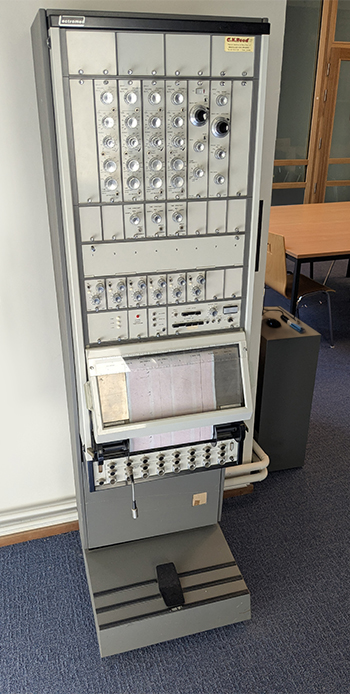
31. Polygraph
Definition:
* With its multiple channels, the polygraph enables simultaneous recording of several physiological parameters.
* It is particularly useful for studying the physiological changes occurring in emotional states.
* This particular device records heart rate, the electrical activity of 4 different muscles (electromyography) and of one site of the cerebral cortex (electroencephalography).
* Acquired in 1977 by the Laboratory of Experimental and Social Psychology, this device is a symbol of the end of electromechanical devices.
* The subsequent generation was to be fully digital.
Operation:
* Each parameter is detected by a “channel” consisting of electrodes placed on a body zone and an electronic amplifier configured for a specific physiological parameter.
* Physiological variations detected by the various channels are transmitted to styluses which transfer them to the thermal paper of a recording device inspired by Marey's cylinder.
* The rotation speed of this cylinder can be modified to suit the researcher's recording requirements.