

Visual perception
ipsy | Louvain-la-Neuve

1. Michotte's bench
Description:
* Conceived by Albert Michotte, this bench was designed for the experimental investigation of the perception of causality.
* It was inspired by the causality perceived on a billiard table : when one ball hits another, the second is thrown, and this movement appears to the observer as “caused” by the impact.
* What are the conditions under which the observer experiences an impression of causality? * The bench displays objects for which movement and contact time can be manipulated.
* This enables the investigation of the conditions favoring the perception of a causal relationship.
Operation:
* The system consists of three discs, each with a red and a black curve with differing shapes.
* During the presentation, the discs are masked by a screen.
* A horizontal window cut out of the screen reveals a segment of the two curves.
* When the disc is rotated, these curves scroll through the window.
* They display two squares whose movements and contact times can be precisely manipulated by adjusting the shape of the curves.
* The observer is asked to report their visual experience.

2. Michotte's projectors
Description:
* This system was created by Albert Michotte as an alternative to the rotating discs of the Michotte bench for the study of causality.
* Two slide projectors are placed side by side on rotating plates.
* An electromechanical system controls the coupled movements of the two projectors.
* The device allowed each projector to be rotated by a few degrees, resulting in a linear displacement of the two images projected onto the screen.
* The electromecanic equipement allowed to modify the speed of movement, the speed ratios and distance covered by the projected images.
Operation:
* The participant is seated facing a screen on which two images move and come into contact according to parameters set by the experimenter.
* The participant is asked to describe what is happening.
* The two projectors are twinned, but with a slight offset.
* So, for example, if the first projector sets an image in motion, then stops just as the second starts projecting a moving image, the participant generally reports the impression that the action of the first image caused the displacement of the second.

3. Ciné Nizo 16mm camera
Description:
* This 16 mm camera, originally designed to be held in hand, is inserted into a device created in Michotte's laboratory for easy use during experiments.
* The camera is mounted on a wooden base and on a vertical panel to ensure perfect stability.
* A simple on-off device is added.
* It consists of a wooden disc which, when rotated half a turn, switches the camera motor on (“O” for Open) or off (“F” for "Fermé" in French, i.e., "Closed").
* A key serves to wind up the spring tensioning the camera's mechanical motor.
Operation:
* The camera is placed in front of the participant whose activity or movements are to be continuously recorded during an experiment.
* The stability and simplicity of the device ensure high-precision recording throughout the experiment.

4. Optical bench
Description:
* The optical bench consists of a metal “rail” on which all types of optical elements can be aligned, moved and transmuted: lenses, magnifiers, mirrors, prisms, diaphragms, light sources, lasers, stimulus presentation screens, etc. etc.
Operation:
* An optical bench enables the experimenter to set up a combination of optical devices to be tested.
* The participant is then placed at the extremity of the bench and instructed to direct his/her gaze along the axis of the device's elements.
* The experimenter collects the participant's verbal responses through which the participant conveys the elements of his/her visual experience.

5. Fauville's tachistoscope
Description:
* Developed by Arthur Fauville in Michotte's laboratory, this optical bench allows visual stimuli to be presented for short periods of time. It consists of (1) a card holder into which the stimulus (word, figure, etc.) is inserted, (2) a rotating disk with an adjustable window that acts as a shutter, (3) a lens that projects the stimulus onto (4) a screen, (5) a lens that magnifies the stimulus, and (6) a headrest fitted with a flap that can cover either eye.
* The device has been designed for use in the study of visual perception, memory and learning.
Operation:
* The window of the rotating disk acts as a shutter.
* Its adjustable size enables the shutter speed to be varied from 10 to 300 msec.
* After this adjustment, the experimenter triggers a system of springs and counterweights.
* This gives the shutter disc a half-turn around its axis.
* During this brief movement, the disc window passes only briefly before the projection lens.
* This is the system ensuring the brief, calibrated, presentation of the stimulus to the participant.

6. Campimeter
Description:
* The campimeter is used for qualitative studies of the visual field.
* It enables measurement of the size of the non-sensitive visual field (“blind spot”) located at the entrance to the optic nerve, where light-sensitive receptors are lacking.
* It can also be used to study sensitivity to chromatic phenomena.
* The retina is not sensitive to all wavelengths.
* At the center of the retina, abundant cones enable the perception of all colors.
* At the periphery, as the number of rods increases, some colors disappear earlier than others.
Operation:
* The participant's head is placed perpendicular to the horizontal axis, and asked to stare at a fixed point facing them.
* A colored dot is moved around the graduated perimeter of the arc circle until the expected visual sensation is obtained: “I see a dot of such and such a color”.
* The same procedure is repeated, starting from varying peripheral positions.
* A systematic exploration of the entire visual field can be carried out by modifying the axis of the campimeter.

7. Color mixing device
Description:
* The device is aimed at demonstrating the visual impressions resulting from color mixing.
* Its 3 disks are composed of sectors of different colors in varying proportions.
* A crank enables the disks to be rotated rapidly.
* As the eye cannot follow the movement, the retinal persistence combines the colors.
* The observer then perceives the result of the mixture.
* The three discs enable the effects of different color combinations to be compared.
Operation:
* Since Newton, it is known that sunlight is composed of the colors of the rainbow.
* This can be demonstrated by rotating a disk composed of the 7 colors of the rainbow : all you see is gray.
* A black-and-white disc produces the same result.
* The same effect can be obtained with 3 colors, such as red, green and blue.
* Two colors are enough to produce gray if they are complementary (yellow and blue, or red and green).
* With non-complementary colors, the countless effects of color mixing can be demonstrated.

8. Spectroscope
Description:
* Designed in 1860 by Gustav Kirchhoff and Robert Bunsen, the spectroscope analyzes the light spectrum, i.e. the components of the light.
* For example, white light is broken down into the colors of the rainbow.
* The central chamber contains a prism around which three tubes are positioned.
* The first tube, the collimator, collects the light emitted by the substance to be analyzed and which is illuminated by a lamp.
* The light passes through the prism and enters the second tube, the telescope, through which the observer sees the decomposed light.
* A third tube, the micrometer, measures the components of the color spectrum.
Operation:
* The spectroscope contributed to the study of complex perceptions that could be decomposed into elementary parts.
* It enabled light to be broken down and to test how participants perceived colors and contrasts.
* It was also used to examine discrimination thresholds between different light intensities, or to study how the eye adapts to constant or variable light stimuli.
* The spectroscope was also used to produce precise light stimuli for experiments.

9. Liebreich's ophthalmoscope
Description:
* The ophthalmoscope enables visualization of the internal structures of the eye.
* Created in 1855 by Richard Liebreich, this model can be held in hand.
* It features a concave mirror with an œilleton and an articulated hinged lens holder.
* It comes with five interchangeable lenses, allowing light to be focused more or less depending on the participant's characteristics.
* Two additional lenses can be used to correct the observer's hyperopia or myopia.
Operation:
* In the experimental study of phenomena of visual perception, it was sometimes necessary to check for eventual peculiarities of the participant's eyes.
* A light source was placed behind the participant.
* The experimenter collected this source on the concave mirror of the instrument and directed it towards the pupil of the participant's eye.
* Through the eyepiece of the ophthalmoscope, the experimenter then inspected the inner part of the illuminated eyeball.
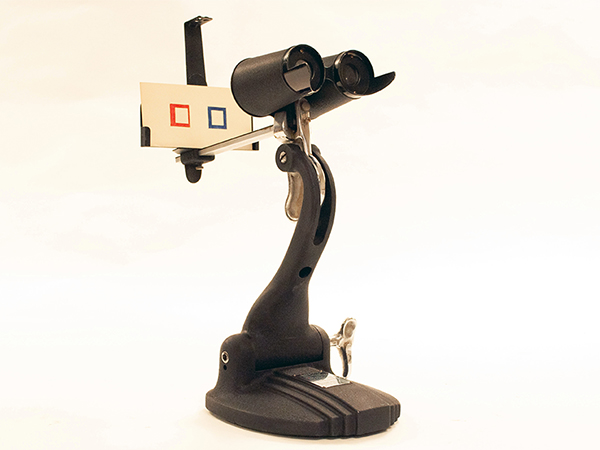
10. Telebinocular
Description:
* These ophthalmic tele binoculars have two functions.
* On the one hand, they constitute an optometric device used for vision testing.
* Second, they provide a tool for viewing stereograms under conditions of high optical quality. * Stereograms consist of two nearly identical photographs or photomechanical prints, matched to produce the illusion of a single three-dimensional image when viewed through a stereoscope.
Operation:
* A stereogram is inserted into the device's stand.
* The stand slides on a graduated ruler, allowing the stereogram presentation distance to be set accurately.
* The user places the eyes before the lenses.
* Whereas conventional stereoscopes feature wedge-shaped prisms 7 mm thick, tele binoculars feature achromatic lenses 21 mm thick. This characteristic confers them far superior resolution.

11. Stereoscope
Description:
* This instrument presents side-by-side two images of a same object taken from a slightly different angle, and viewed through a pair of lenses.
* These images merge in the observer's mind into a single virtual plane image, producing a 3D impression.
* The device reproduces the process of perception in relief, which is formed because the brain reconstitutes the two distinct plane images from each eye into a single visual model.
Operation:
* The upper part of the stereoscope is lifted and a “stereo” image is inserted.
* On the millimetric scale of the stereoscope frame, the distance of the left edge of the stereo image is measured.
* The distance of the lenses is then adjusted by rotating the rings.
* On this particular device, the lens distance is set according to the width of the image, and not according to the distance between the eyes, as is the case with binoculars.