

Sensory-motor processes
ipsy | Louvain-la-Neuve

12. Dexterity or “mousetrap” test
Description:
* This is a psycho-technical test designed to measure finger and hand dexterity.
* Created by Walther Moede in 1929 as the “puck threader”, it has also been called the “wire maze” and the “mousetrap”.
* The device consists of a wire measuring 2 meters in length.
* It is twisted irregularly and comprises 29 bends with various angles.
* Metal discs, each pierced with a 5 mm hole, are threaded onto a straight, vertical part of the device.
Operation:
* The participant must drag all the discs as quickly as possible, following the meanders of the twisted wire, and then return them to their initial position.
* This simple but somewhat time-consuming task provides information not only on the participant's dexterity, but also on their perseverance in completing a fairly lengthy task, which is an important element in routine tasks.

13. Demoor's size-weight illusion
Description:
* Demoor's size-weight illusion is a classic example of the phenomenon of inter-modular interactions in the perception of objects.
* In the present example, interactions between visual and kinesthetic information are at stake.
* Although the two objects have the same weight, the more voluminous of the two seems heavier.
Operation:
* When lifting an object, visual information - the size of the object - takes precedence over kinaesthetic information.
* Visual information even impacts on the control of the motor action exerted towards the object to be lifted: greater muscular force is developed to lift the more voluminous one, and thus seemingly heavier.
14. Differential weight perception
Description:
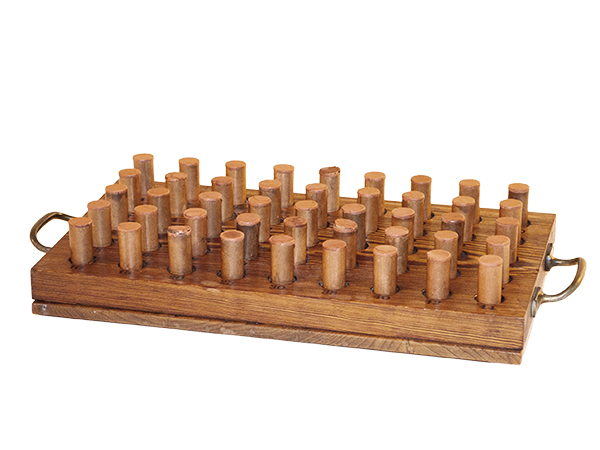
* This device was designed to investigate the ability to detect differences in weight.
* It consists of 45 cartridges, each with a different weight.
* Weights range from 10 grams to 100 grams, with a gap varying from 1 to 5 grams between two cartridges.
Operation:
* The participant was asked to compare two objects of different weights by holding them in hands.
* The question was whether or not they perceived a difference in weight between the two objects.
* This enabled establishing the “differential threshold”, i.e. the smallest difference between two weights that could be detected by the participant.

15. Kinesimeter
Description:
* The kinesimeter is a device designed by Albert Michotte as part of his research into kinaesthetic memory, i.e. the ability to remember performed movements.
* The device consists of a 50-cm graduated scale surmounted by a metal rod on which is located a movable cursor slidable between two buffers.
* It is designed to assess the accuracy of reproducing a movement once the participant is guided solely by kinaesthetic sensations.
Operation:
* The participant is invited to move a cursor up to a buffer.
* They are asked to repeat the same gesture several times, so as to memorize the distance covered by the cursor.
* The stopper is then moved by the experimenter, and the participant has to retrieve the initial position of the buffer, but with eyes closed.
* The graduated scale enables measuring the difference between the initial position and the position estimated with eyes closed.

16. Cinesigrams
Description:
* Cinesigrams show the photographic trace of a hand movement performed by a participant on a horizontal plane placed in front of them.
* They were used in the investigation of the transformation of movements when they are repeated rapidly.
* A small light bulb was attached to the tip of the participant's finger.
* A camera positioned above the horizontal plane recorded the successive movements of the hand in the dark, taking a bird's-eye view of its luminous trajectories.
* The film was developed frame by frame, producing a large number of movement photos.
* Gérard de Montpellier, who later succeeded Albert Michotte, used this device for his doctoral thesis.
Operation:
* Simple movements of the hand and arm were executed under specified conditions of speed and accuracy.
* In tracing reactions (analogous to writing), the participant had to follow the contours of given geometric figures.
* In typing reactions (analogous to typing), the participant had to hit, in a specified order, several targets disposed on a keyboard.

17. “Ciné Photo Sept” camera
Description:
* The Ciné Photo Sept is a uniquely designed camera that was very popular in Hollywood to name but one.
* Developed in France by André Debrie in the 1920s, it uses 35mm perforated film (24 x 36 format) in dedicated cassettes.
* The variable-speed revolving shutter is driven by a spring motor. The lens (1:3.5/50mm) is interchangeable.
* The chrome knob at bottom left enables selection between continuous shooting, pose and instant.
* The screw at the bottom adjusts the speed in camera mode.
* The back of the body reveals the frame counter (0 to 255 in steps of 5).
* The round cap, once removed, can be used to attach a lamp for projection.
Operation:
* Unique in this respect, the Ciné Photo Sept combines 7 functions in a single device.
* (1) camera in single-frame mode, (2) camera in continuous mode, (3) sequential shooting (cartoons) with associated lamp, (4) slide projector (still or animated films), (5) cinema projector, (6) negative-to-positive sorter, (7) enlarger.

18. Target response (2 models)
Description:
* These two devices are designed to assess dexterity in tasks requiring high precision.
* The first one features two parallel sawtooth-shaped paths.
* The second consists of a metal plate with a series of progressively smaller holes.
* In both cases, a metal stylus is connected to the device.
* Each device is equipped with a visual or audible electrical system that signals imprecise movement.
Operation:
* In the first device, the participant must follow the sawtooth pattern without touching the edges.
* In the second model, the participant must insert the stylus into the calibrated holes.
* The task becomes increasingly difficult as the holes get smaller and smaller.
* In either case, as soon as the stylus touches an edge, an electrical circuit is closed, activating the audible or visual signal.
* The signals are tallied by the experimenter.
* The task can also be made more complex by imposing a rhythm or delay on the participant, through the use of a metronome or stopwatch.
19. Tapping board
Description:
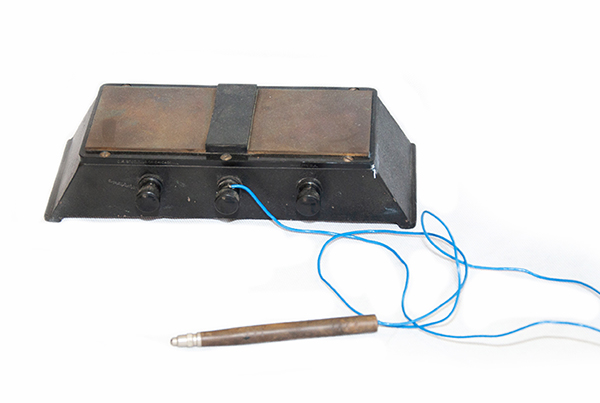
* This device has been designed to investigate one of the most basic forms of psychomotricity.
* It enables assessment of fine motor skills, notably speed, precision and coordination of movements.
* Such performance is involved in typing, for example.
* The tapping board remains a versatile tool in experimental psychology, useful for understanding relationships between the brain, movement and various cognitive or pathological states.
Operation:
* The task consists simply in tapping as quickly as possible, using a stylus, on either one or both of the two squared steel plates.
* The number of strokes is recorded using either a kymographic or a chronographic device.
* The experiment generally lasted a maximum of 10 minutes, to avoid over-fatigue on the part of the participant.

20. Handling test
Description:
* This device features 50 threaded rods arranged at regular intervals on a metal board.
* The device also includes a round nut that can be screwed onto the rods.
* The test assesses dexterity and the organization of movement in a sequence.
Operation:
* The participant was asked to screw, then unscrew, the nut onto each of the 50 rods in the array, row by row from left to right, until the entire array had been traversed.
* Each screwing had to be done completely, which was ensured by the click of a numerator inserted in the electrical circuit of the panel.
* The participant repeated the exercise twice, with a 5-minute rest interval.
* The exercise is slightly more complex than the one in the typing experiment (device no. 19), due to the high motor precision required and the sequence imposed on the participant.