

Mobility in transition: ideas in motion
eli | Louvain-la-Neuve

What if tomorrow's mobility were being built today at UCLouvain? For the past five years, the OpenLab Transition Mobility has been exploring, testing and imagining solutions to transform the way we travel and reinvent our territories.
On 3 September, a meeting organized by Barbara Stinglhamber, researcher at the Earth and Life Institute, brought together more than 80 participants to share the results of interdisciplinary research and open up new avenues.


The ecological transition is forcing us to rethink the way we travel and imagine new ways of developing our territories. At UCLouvain, the OpenLab Transition Mobility embodies this dynamic, bringing together six faculties around an interdisciplinary approach. On 3 September, more than 80 people gathered at Louvain House to celebrate this anniversary and share the results of research conducted over several years.
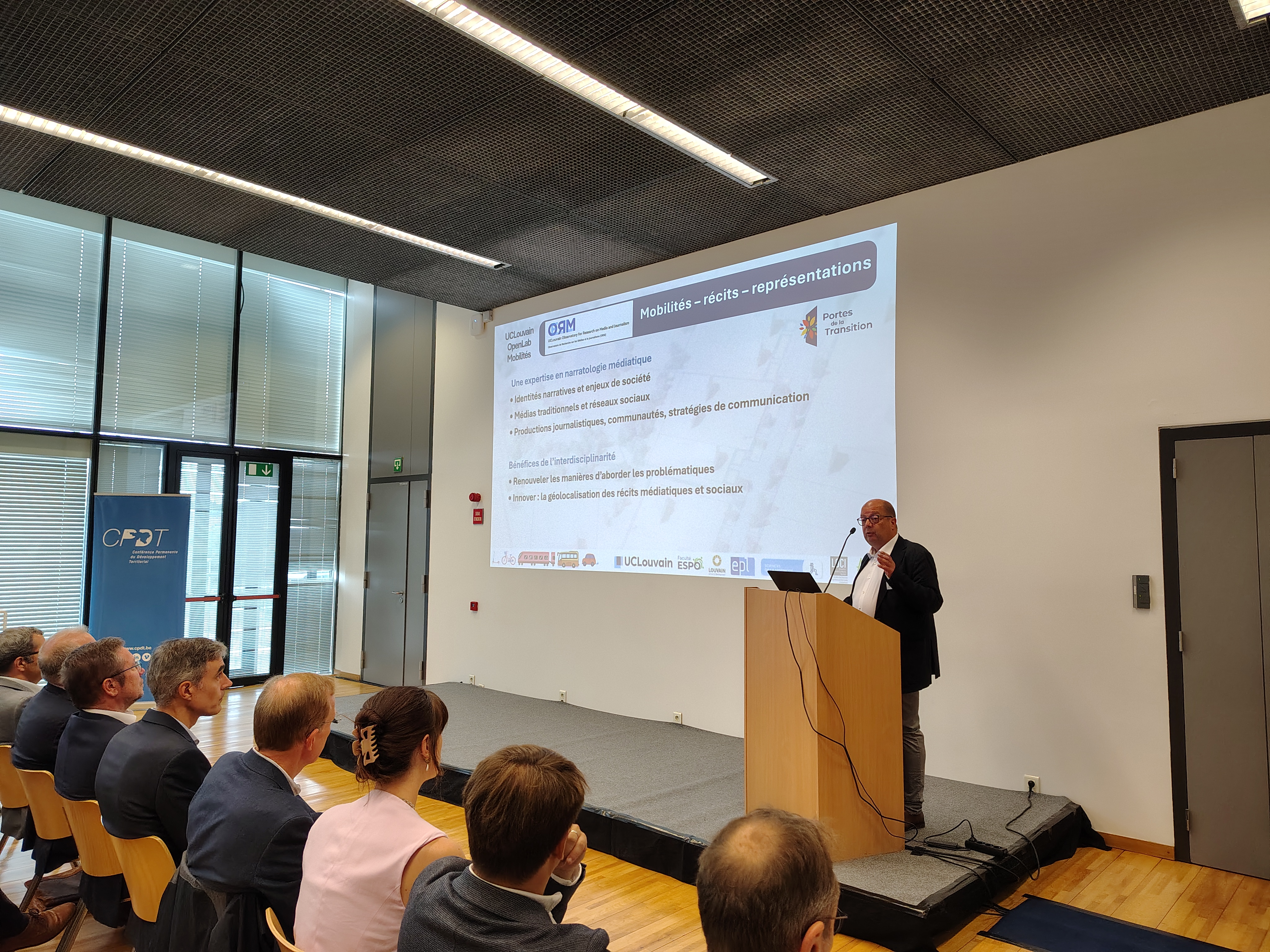
Funded in particular by the SPW-MI, the CPDT and as part of cross-border initiatives, the projects carried out by the members of this ‘lab’ have shed light on key issues:
- How can we encourage a modal shift towards cycling?
- What role should buses play in the restructuring of the Walloon network?
- What strategies are companies developing to address the daily mobility needs of their employees?
- How can we better meet the specific needs of sparsely populated areas?

The event opened with a welcome from university authorities and a speech by François Desquesnes, Walloon Minister for Territory, Infrastructure, Mobility and Local Authorities, who emphasised the importance of dialogue between research and political action.

The morning then unfolded with scientific presentations, followed by a summary by Professor Xavier Tackoen (Espaces-Mobilités and UCLouvain) and an interactive Marketplace of Experiences session.

This format encouraged dialogue between researchers, operators and actors in the field, confirming the role of the university as a space for meeting and reflection.


Finally, a convivial walking lunch extended the discussions in an atmosphere conducive to networking and the co-construction of concrete solutions.

With this forum, OpenLab Mobility demonstrated the relevance of its interdisciplinary approach: combining academic knowledge and practical experience to jointly invent the mobility solutions of tomorrow.
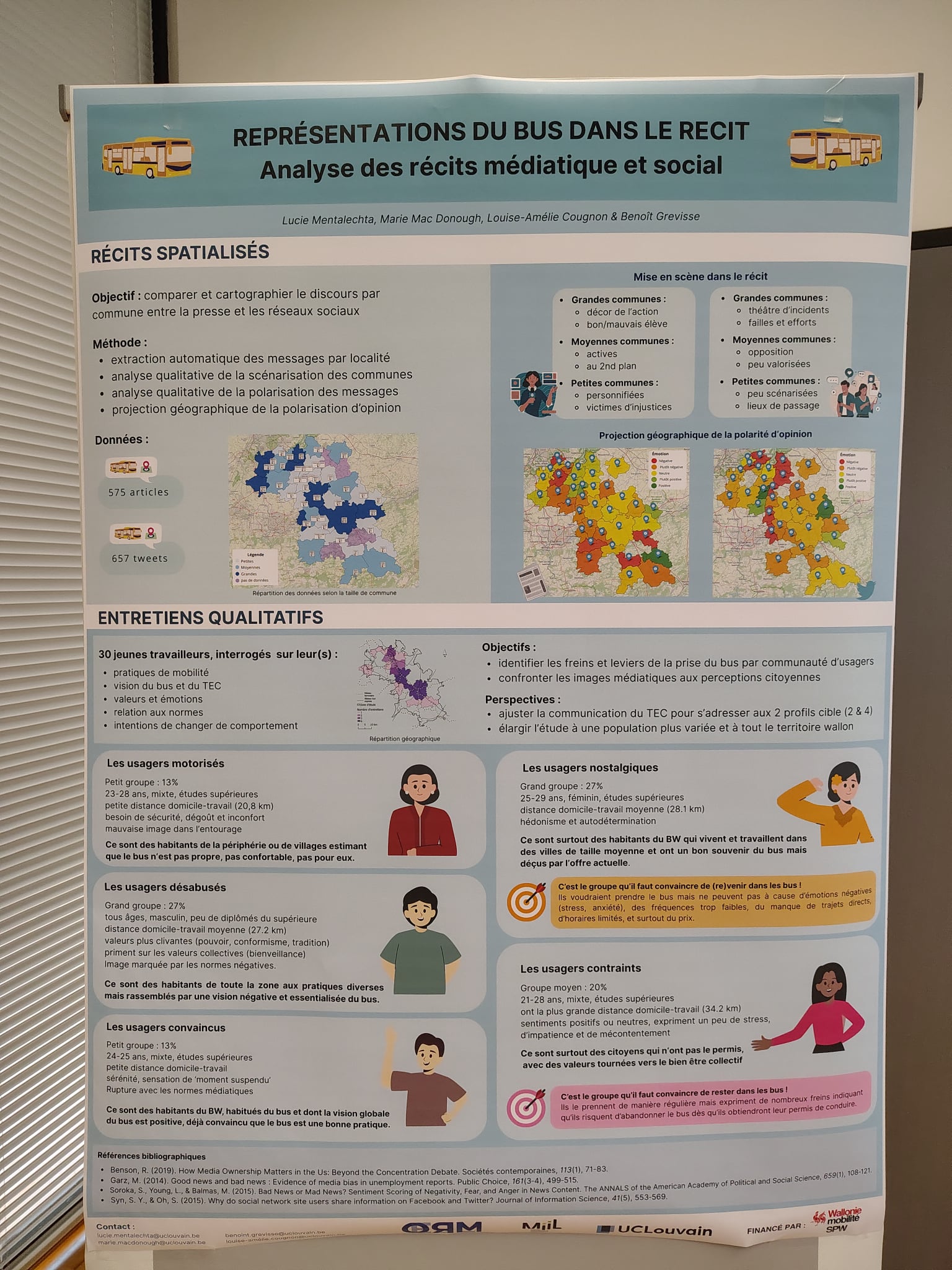

From cycling to public policy: rethinking mobility

Among those involved in this debate, Barbara Stinglhamber, a researcher at Earth and Life Institute, UCLouvain, sheds particular light on the role of science in this field and how it can inspire concrete change.
From electric bikes to public policy, via the OpenLab Mobility, Barbara advocates a multidisciplinary and pragmatic vision of the mobility of tomorrow.
In your thesis, you focused on the modal shift towards cycling. What key findings would you like to share with a wider audience today?
Barbara: First and foremost, not everyone will be able to use a bicycle for all their journeys. The aim of my research is to identify the journeys and profiles of people for whom this modal shift is possible and feasible.
Our choice of transport mode is governed by geographical criteria (suitable infrastructure, compatible distances), personal criteria (access to a suitable vehicle, knowledge of the highway code, physical and mental ability to travel), and social criteria (the collective image of a mode of transport has a huge influence on the desire to adopt it. For example, the image of the ‘bobo on a bike’ may reinforce the desire to cycle among those who identify with this group, but have the opposite effect on others). It is essential to consider these different dimensions when drawing up policy plans to promote modal shift (changing modes of transport for a given journey).
Public policies often focus on infrastructure – cycle paths, bicycle racks – but beyond their implementation, their relevance (quality, location) is crucial. Above all, they must be complemented by awareness-raising and training initiatives, so that the population not only has the ability but also the desire to take up cycling. A multidimensional approach is key to any mobility policy, regardless of the mode of transport targeted.
Despite progress, certain obstacles to cycling remain. Which ones do you think are the most difficult to overcome, and why?
In Wallonia, it is primarily the social image of cycling that is hindering its wider adoption. Cars are omnipresent in people's minds and are associated with social advancement: owning a car is synonymous with success, coming of age with a driving licence, and independence. We need to change the image of cycling: it is sometimes perceived as old-fashioned and reserved for “poor” people, and sometimes as a marker of “rich environmentalists”.
Non-cyclists often cite hills and weather as obstacles, whereas regular cyclists consider these to be minor daily inconveniences. This rebranding effort must also extend to all modes of transport: buses are perceived as uncomfortable and unreliable, trains are always ‘late’, etc. These stereotypes are slowing down the transition. But changing societal perceptions takes time: the results are only visible in the long term, which makes these policies difficult to implement within a single political term.
In organising this meeting, what role would you like research to play in the practical development of mobility practices?
Firstly, I would like the scientific community to become fully aware of the multidisciplinary nature of mobility issues in transition, and for this to pave the way for more multi- and transdisciplinary research. I would also like to see these results reach beyond the academic world. I have always been convinced that research should serve the field. It is important to popularise and share results in an educational manner, so that political and strategic actions can be based on recent scientific knowledge.
Academic studies are often exploratory and innovative, but they are nonetheless concrete and applicable. I believe that this aspect is still under-utilised by public and private organisations, which could nevertheless draw on it to develop relevant mobility strategies.

From thesis to change of direction: an expert in mobility
First a bioengineering student at UCLouvain, Barbara Stinglhamber initially intended to study chemistry before turning her attention to environmental issues. Her thesis on the potential of cycling for commuting was a turning point: not only would 30% of staff benefit greatly from electric bikes, but she herself became a committed cyclist.
After an internship and then a job in the environmental department of the town of Ottignies-LLN, a doctoral scholarship from the Permanent Conference on Territorial Development (CPDT) enabled her to further her research on mobility.
Four and a half years and three bicycles later, Barbara is looking to put her expertise to work on concrete projects to bring about lasting change in travel behaviour.
"I began my bioengineering studies at UCLouvain with the idea of specialising in chemistry. During my bachelor's degree, I realised that I was more interested in environmental issues. So I chose a master's degree in environmental studies, with a focus on land use planning. I wanted to work on current issues while maintaining a local dimension.
My thesis focused on the potential of cycling for the commute of UCLouvain staff in Louvain-la-Neuve. I showed that nearly 30% of staff would not lose any time by coming to work on an electric bike rather than by car!
Having never been a cyclist myself (I come from the Condroz region, where the hilly terrain had long discouraged me), I was the first to be surprised by these results. I got my first bicycle at the end of my thesis, and that was the beginning of a great story: today, I mainly get around by bicycle."
At the same time, Barbara completed an internship in the works and environment department of the town of Ottignies-Louvain-la-Neuve, where she was hired. She then obtained a PhD scholarship funded by the CPDT, which enabled her to continue on a larger scale what she had started in her thesis.
Four and a half years later, she is looking for new professional challenges related to mobility. "Cycling has been a wonderful gateway for me, but I am convinced that we need to take action on all modes of transport. Today, I aspire to put my expertise to work on concrete projects to support changes in mobility behaviour."

The OpenLab Mobility: scientists from six entities
The OpenLab Mobility aims to be an umbrella organisation bringing together researchers working on the same subject, mobility, with different approaches and methodologies.
The objective? To promote multi- and transdisciplinarity. "We are convinced that it is by bringing together multiple disciplines that we can obtain the most comprehensive view possible of the issues at hand."
The OpenLab Mobility was created as part of the University's Transition Plan, to support the institution in its own transition policy. "Our research therefore aims both to produce knowledge and to advance the University towards its objectives."
Congratulations to Dr. Barbara Stinglhamber, Pr. Pierre Defourny, Pr. Yves Hanin, Pr. Benoît Grevisse, Ségolène Bauduin, Pr. Bas de Geus, Thibault Decoene, Lucie Mentalechta, Joachim Dupont, Pr. Xavier Tackoen for their research and the success of the forum on 3 September.
You were unable to attend on 3 September but you would like to find out more about this research? You can find here the PowerPoint presentations given at the forum.
This article was originally written in French by the AREC team of UCLouvain. It is available to be read here.