

Making agricultural systems more sustainable through human and economic perspectives
eli | Louvain-la-Neuve

The ecological transition is probably the most important challenge humanity will face this century.
To make this transition a success, all disciplines need to be involved. It's a deeply trans- and interdisciplinary challenge.
At the Earth and Life Institute, one research group particularly embodies this interdisciplinarity. Goedele Van den Broeck's team is known as the “Agrifood Economics Group”, and their research focuses on making agrifood systems more sustainable from several different angles.
Their mission? To conduct impactful research and education on sustainable agrifood systems, where they deliver new scientific insights on real-world challenges using innovative data and methods, contribute to ongoing policy debates, and train tomorrow’s leaders in agrifood systems transitions.
Their strategy? Research and education that are grounded in agricultural and food economics, with frequent collaboration across disciplines.
The team focuses on three main themes of research: (1) adoption of sustainable agricultural practices, (2) global and local food value chains, and (3) monitoring and certification.
Adoption of sustainable agricultural practices
What does the word “sustainable” mean? What does it imply in everyday life? We all know that we need to move towards more sustainable food systems, but what does that mean in practical terms for farmers on the ground? This is what researchers in Goedele Van den Broeck's team are studying.
“More sustainable practices include agroforestry, conservation farming, and drastic reductions in pesticide use. What we do is go out into the field, under real conditions, to see what adopting such practices means for farmers from an economic, social, and environmental perspective”, she explains.

The team works from an actor-centered approach by examining all other links in the value chain: consumers, farm workers, agri-food companies, traders, and certification bodies, which are responsible for awarding certificates attesting that farmers practice organic or fair-trade agriculture, for example.
In order to gain a precise and systemic understanding of the phenomena studied, several types of analysis are combined: quantitative analyses, which consist of collecting a large amount of numerical data, which are then analyzed using models (in this case, econometric models); and qualitative analyses, which consist of conducting interviews with individuals or groups of individuals and analyzing their discourse to uncover new patterns and insights.
These methods allow the team to analyze complex local and global realities.
Global and local food value chains
With globalization, our food systems have become very complex. Spontaneously, we tend to think that consuming locally is necessarily more sustainable, and that farmers benefit more. However, research by Goedele Van den Broeck's team shows that this is not always the case. The impact of local food systems on farmers highly depends on how they are embedded in the value chain. While farmers may capture more value and benefit from higher prices when there are fewer intermediaries, they also face additional costs linked to marketing and transportation.
In general, the team pays specific attention to phenomena that can have highly heterogeneous effects. This means that behind the averages, the realities of farmers in the field are sometimes very different from one another.
“Another example of a preconceived notion that does not necessarily hold true is that international trade is harmful to our planet. In some aspects, it can indeed contribute to worsening conditions, particularly linked to environmental issues like deforestation. But the internationalization of food trade also ensures a certain level of food security, especially for countries in the Global South. Without this global “safety net,” some populations would face severe famine risks.”
To fully understand these very different food realities in different countries, the team is conducting research on several scales: in Belgium (Wallonia and Flanders), but also in several countries in Africa and South America.

Monitoring and certification
Who hasn't bought a product because it was labeled “Organic” or “Fairtrade”? The value of certain food products today is largely dictated by these labels.
This is a good thing because it allows consumers to choose more sustainable or responsible food, and it allows farmers who adopt sustainable practices to be valued and better compensated.
“But for the system to work properly, monitoring is needed to ensure that labeled products meet the label's criteria, both at the time of certification and thereafter. However, this monitoring comes at a cost that not all farmers can afford. The system is therefore unequal and tends to favor the largest players.”
The importance of a gender perspective
Where relevant, the team also integrates perspectives from minorities, with particular attention to gender, youth, and migrants.
For instance, in a recent publication entitled “How does gender shape the adoption of sustainable agricultural practices? Evidence from Belgium”, doctoral researcher Sophie Henrotte and Goedele Van den Broeck examine the issue of gender in agriculture.
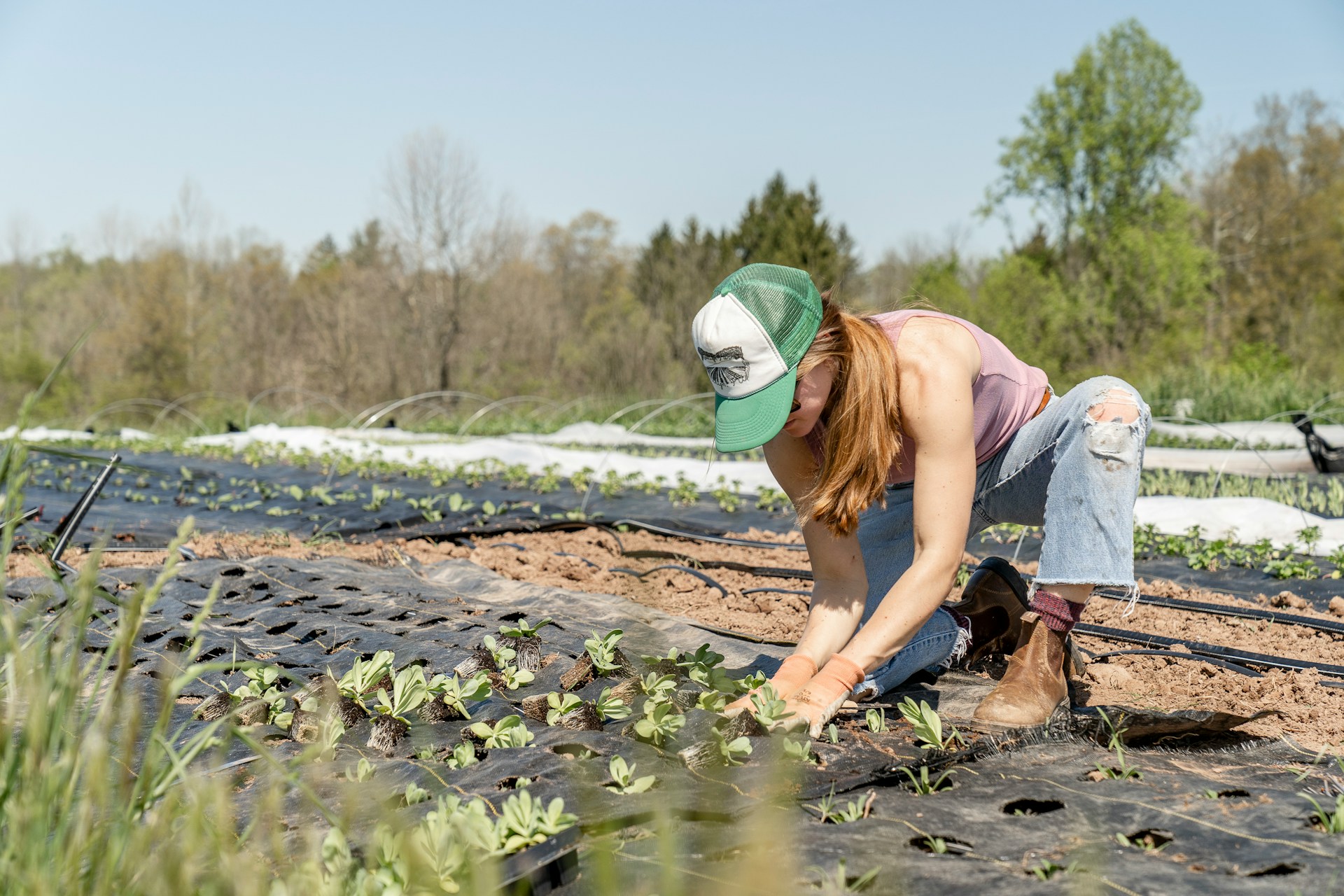
Using mixed methods (qualitative and quantitative) analysis, the researchers examine the role that gender can play in the implementation of sustainable practices in agriculture and demonstrate significant effects.
In some cases, being a woman farmer can be a lever for implementing sustainable agricultural practices. For example, they are more conscientious in their use of pesticides.
But in most cases, being a woman proves to be more of an obstacle.
“In fact, women farmers are, on average, older than their male counterparts because they often inherit the farm upon the death of their partner. They also rely more on subcontractors, leaving more decisions about their farm to other people, who may not necessarily have an interest in taking care of land that does not belong to them.”
Offering solutions
Beyond these findings, Goedele Van den Broeck emphasizes the importance of proposing solutions to the problems studied and their implementation.
The team is therefore taking every opportunity to meet policy makers and share the conclusions of their research, particularly with the European Commission and Parliament.
“At this stage, gender is not a factor that is taken into account by the EU in agriculture. There is no differentiation between men and women farmers. However, we can see that their realities on the ground are different. Policies must be gender-inclusive. Therefore, it is encouraging to see that the proposals for the new CAP (Common Agricultural Policy) are moving in that direction.”
They are also involved in interdisciplinary projects with other research teams, for example in the fields of geography, agronomy, nutrition, ecology, and even volcanology.

Care, rigor, and commitment
This desire to work towards making the world more sustainable also has applications within the research group itself.
The team stands by its values of care, rigor, and commitment. And it applies them to itself as well.
“I think it's very important that there is a good dynamic within our research group”, insists Goedele Van den Broeck. “The well-being of researchers is very important to me. We are living in difficult times, and it can be easy to get discouraged. But we are here to support each other and stay focused on what we can control and what we can try to change.”
The team

Goedele Van den Broeck, Assistant Professor in agricultural economics and food policy
Steffi Dekegel, PhD Candidate
Omar Frikhat, PhD Candidate
Amare Molla Dinku, PhD Candidate
Apoorva Vardhan, PhD Candidate
Lisa Vanderheyden, PhD Candidate
Aurel Houkpatin, PhD Candidate
Thomas Bentze, PhD Candidate
Sophie Henrotte, PhD Candidate
Hind Dib, Researcher
Some references
Henrotte, S., & Van den Broeck, G. (2026). How does gender shape the adoption of sustainable agricultural practices? Evidence from Belgium. Journal of Rural Studies, 121, 103919.
Van den Broeck, G. The future of food security: three main avenues for research on trade in food systems. Food Security. (2025). https://doi.org/10.1007/s12571-025-01572-2
Enthoven, L., & Van den Broeck, G. (2021). Local food systems: Reviewing two decades of research. Agricultural systems, 193, 103226.
Article: Emmeline Van den Bosch and Goedele Van den Broeck's team