

Adults
ipsy | Louvain-la-Neuve
Numerical Cognition in Adults Lab

Brain storming week-end in Beffe (B), June 2017
From left to right: Nicolas Masson, Samuel Di Luca, Valérie Dormal, Michael Andres, Laurie Geers, Mauro Pesenti, Samuel Salvaggio
We study numerical cognition in adults with the aim to define the functional components of number processing and calculation and find their neuroanatomical correlates. We use complementary methodologies integrating the functional and neuroanatomical levels of analysis: mental chronometry, functional brain imaging (fMRI), and lesional data examining the performance of brain-damaged patients or healthy adults undergoing transient interference from neurostimulation (TMS) or neuromodulation (tDCS, tRNS). We investigate how the brain processes numerical and non-numerical magnitudes, and how sensory-motor, language and/or attentional processes support the abstract meaning and the computations performed on numbers.


A large amount of research demonstrated that adults are able to process numbers in the symbolic as well as in the non-symbolic code. According to Verguts and Fias (2004), there are qualitative differences in the coding of quantity as conveyed by symbolic and non-symbolic formats: symbolic numbers are processed with a place-coded representation whereas non-symbolic numerosities are processed with a summation-coded representation (see also Roggeman, Verguts & Fias, 2006). Moreover, besides their differential coding, symbolic and non-symbolic representations also present differential scaling; the symbolic representation being linearly scaled (Verguts, Fias & Stevens, 2005) and the non-symbolic representation being logarithmically compressed (Dehaene, 1992; Verguts & Fias, 2004).
The aim of our work is to examine how these different features influence numerosity estimation performances.
Schematic representation of (A) the place-coded and linear symbolic representation and (B) the summation-coded and logarithmic non-symbolic representation. The red segment corresponds to the portion of the representation which is activated when the magnitude 40 is processed.
Study of the under- and over-estimation process
For example, in this study, adult participants were submitted to three types of numerical estimation task: 1) a perception task, in which participants had to estimate the numerosity of a non-symbolic collection; 2) a production task, in which participants had to approximately produce the numerosity of a symbolic numerical input; 3) a reproduction task, in which participants had to reproduce the numerosity of a non-symbolic numerical input. Results showed that different patterns of performance were found according to the task used: 1) under-estimation in the perception task; 2) over-estimation in the production task; 3) accurate estimation in the reproduction task. We discussed these data by showing how they can be accounted by the direction of the mapping process that takes place between the logarithmic mental number line and the linear symbolic representation.
- Crollen, V., Castronovo, J., & Seron, X. (in press). Under- and over-estimation: A bi-directional mapping process between symbolic and non-symbolic representations of number? Experimental Psychology. PubMed


Principal Investigators: Mauro Pesenti, Michael Andres
A large amount of research demonstrated that adults are able to process numbers in the symbolic as well as in the non-symbolic code. According to Verguts and Fias (2004), there are qualitative differences in the coding of quantity as conveyed by symbolic and non-symbolic formats: symbolic numbers are processed with a place-coded representation whereas non-symbolic numerosities are processed with a summation-coded representation (see also Roggeman, Verguts & Fias, 2006). Moreover, besides their differential coding, symbolic and non-symbolic representations also present differential scaling; the symbolic representation being linearly scaled (Verguts, Fias & Stevens, 2005) and the non-symbolic representation being logarithmically compressed (Dehaene, 1992; Verguts & Fias, 2004).
The aim of our work is to examine how these different features influence numerosity estimation performances.

Schematic representation of (A) the place-coded and linear symbolic representation and (B) the summation-coded and logarithmic non-symbolic representation. The red segment corresponds to the portion of the representation which is activated when the magnitude 40 is processed.
For example, in this study, adult participants were submitted to three types of numerical estimation task: 1) a perception task, in which participants had to estimate the numerosity of a non-symbolic collection; 2) a production task, in which participants had to approximately produce the numerosity of a symbolic numerical input; 3) a reproduction task, in which participants had to reproduce the numerosity of a non-symbolic numerical input. Results showed that different patterns of performance were found according to the task used: 1) under-estimation in the perception task; 2) over-estimation in the production task; 3) accurate estimation in the reproduction task. We discussed these data by showing how they can be accounted by the direction of the mapping process that takes place between the logarithmic mental number line and the linear symbolic representation.
- Crollen, V., Castronovo, J., & Seron, X. (in press). Under- and over-estimation: A bi-directional mapping process between symbolic and non-symbolic representations of number? Experimental Psychology.
Under- and over-estimation: A bi-directional mapping process between symbolic and non-symbolic representations of number?
Adults, infants and animals process and represent numerosity, time and length and they use these quantitative dimensions to guide learning and behaviour. From a broad range of behavioural, physiological, developmental, lesional and neuroanatomical data on magnitude processing, Walsh (2003) recently proposed the existence of a generalised magnitude system located in the parietal cortex.
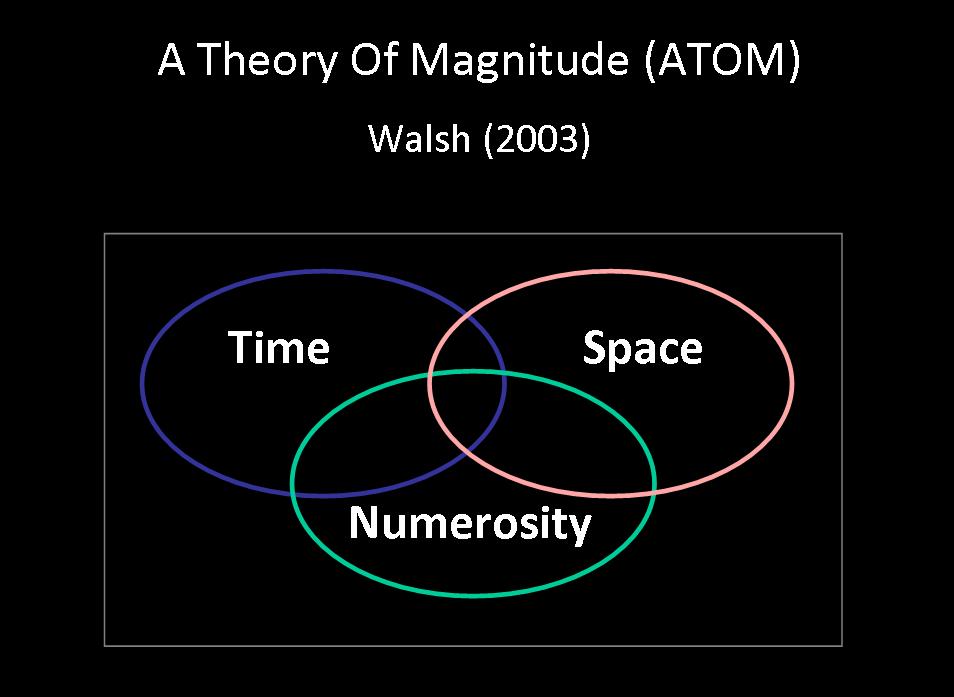
By using behavioral and neuroimaging techniques (fMRI, TMS, ERPs,...), the main aim of our work is to lead to a better understanding of the representational and cerebral organisation of the magnitude system.
Members active in this area include: Michael Andres, Valerie Dormal, Stéphane Grade, Nicolas Masson, Mauro Pesenti
Links between Numerosity and Time
Behavioral study
For exemple, in this first study, the existence of a possible common mechanism for duration and numerosity processing was tested with a Stroop task. Participants had to compare either the duration or the numerosity of sequences of flashing dots for which the duration and numerosity were independently manipulated to create congruent, incongruent or neutral pairs.
Results show that the numerical cues interfered with duration processing, whereas the temporal cues did not interfere with numerosity processing. These findings extend the idea of an automatic access to magnitude to non-symbolic sequentially presented material, and reflect a probable difference in the mandatory processing of numerosity and duration.
- Dormal, V., Seron, X., & Pesenti, M. (2006). Numerosity-duration interference: A Stroop experiment. Acta Psychologica, 121, 109-124.
Numerosity-duration interference: A Stroop experiment.
Links between Numerosity and Length
fMRI study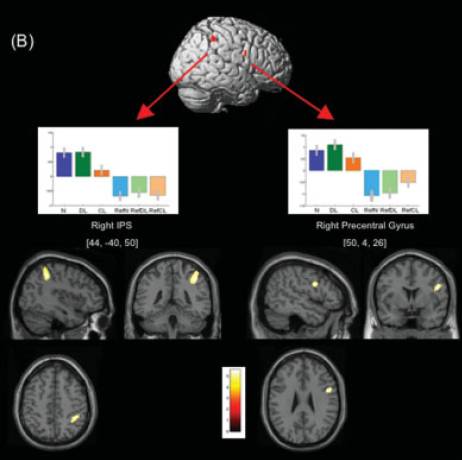
In this study, functional magnetic resonance imaging was used to localize the cerebral network involved in processing both numerosity and length. Blood oxygenation level-dependent signal changes were measured while healthy volunteers were making numerosity comparisons on linear arrays of dots, and length comparisons on discrete linear arrays of dots and continuous rectangles.
The results show the bilateral involvement of parietal regions around the intraparietal sulci in explicit and implicit processing of numerosity, and a right lateralized occipitoparietal network activation in length processing; numerosity and length processing both activate the right IPS and the precentral gyrus. By excluding the mandatory intrinsic spatial processing of arrays, we demonstrate that the left IPS is involved in numerosity processing only, whereas the right IPS underlies a common processing mechanism or representation of spatial and numerical magnitude.
- Dormal, V., & Pesenti, M. (2009). Common and specific contributions of the intraparietal sulci to numerosity and length processing. Human Brain Mapping, 30(8), 2466-2476.
Human Brain Mapping | Neuroimaging Journal | Wiley Online Library